

Could happy wan be the name of Alibaba’s next video model? As of November 13, 2026, that name does not appear in Alibaba Cloud Model Studio’s public release notes. The November timing has a clearer source. On September 22, Shanghai Securities News reporter Yang Xiangfei cited people at Alibaba who said at the Apsara Conference that the company planned to release its next video model in November. The report gave neither a product name nor a specific day.
The speculation draws on the history of HappyHorse and Wan, two Alibaba video model families. Their teams reportedly came together in July, and filmmakers have already used both models on the same short.
What happened to the HappyHorse and Wan teams?
On July 16, the Chinese industry newsletter Shenma’s Circle (申妈的朋友圈) reported that the Wan team had moved into Alibaba vice president Zhang Di’s Future Living Lab, the group behind HappyHorse. Yicai’s Xinpiceng (新皮层) also described the move in its September reporting. That puts the people working on both families in the same lab. How they might combine their work in a future model is still an open question.
Consider what each team has already shipped. Alibaba Cloud’s June release notes say the reference-to-video version of HappyHorse 1.1 accepts up to nine reference images to guide the appearance of people, objects and scenes. In August, Wan 3.0 launched with video and sound in clips of up to 30 seconds, taking direction from text, images, audio and video. Put those capabilities together and a filmmaker has a good question. Could one model keep an actor, a prop and an unfinished gesture consistent across several camera cuts in a longer scene?
Why happy wan? Take “Happy” from HappyHorse and add the name of the Wan team. Third-party creative sites already use both Happy Wan and the one-word spelling HappyWan. Alibaba has yet to confirm either as the name of its next model.

Shanghai Securities News, Yang Xiangfei, September 22, 2026. The Chinese headline refers to Alibaba’s next-generation video model and gives a month. It leaves the name open.
A short film that already credits both models
In the Youku AI Short Drama Workshop film 尾巴 (Tail), telling a lie has a visible consequence. The liar grows a tail. On September 28, the verified HappyHorse_AI Weibo account credited both HappyHorse 1.1 and Wan 3.0 in its post about the film. It did not say which model made which shots.

HappyHorse_AI, September 28, 2026. The post, captured on Sina’s public page, names both models together in the production credit.
There’s a writing idea here that works even with the sound off. Give an invisible feeling a physical consequence. Imagine a shopkeeper locking up who hears someone call his name. A wide shot tells us he’s leaving. A close-up catches the key stopping just short of the lock. The audience can see the hesitation. For a different take, the train-platform storyboard on happy wan moves from a traveler and a waiting train to a hand tightening around a bag.
Three shots to try if happy wan launches
The Apsara Conference report described a goal of giving creators control over shots while keeping characters and locations consistent in longer videos. Save a small set of reference images now and you’ll have a way to try that claim on your own material. These three exercises each give you a particular moment to look for on playback.
A short drama with one blue mug
Take a reference photo of a potter holding a mug, then a close-up of its handle. Give the scene one sound you can place precisely in time. Here’s a prompt you can use as a shot list.
Afternoon window light in a pottery studio. Medium shot of a potter in an indigo apron holding a cobalt-blue mug by its single handle in her right hand. Cut close as she lowers the mug onto a wooden table. One soft clink as the base touches the wood. Cut to a medium side view. She lets go. Hold on the mug for a beat.
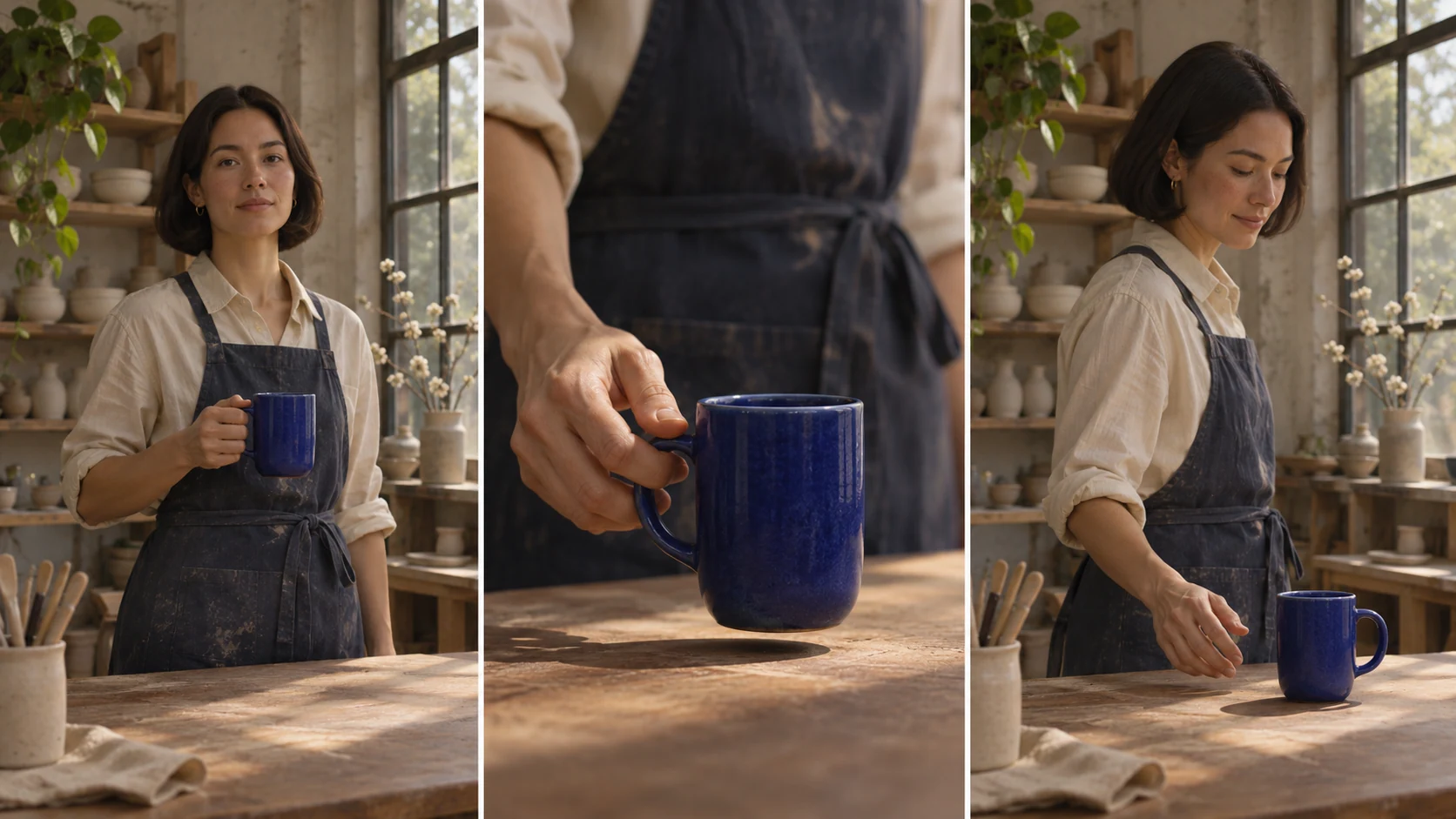
AI-generated editorial storyboard. Follow the hand, the handle’s position relative to the fingers, and the moment the potter lets go.
Watch once on mute. Does the mug switch hands at the cut? Does it land twice? Then listen for a clink that arrives before the mug touches wood. If the close-up jumps, try using the last frame of the preceding shot as the starting image for the next. Our guide to multi-shot short videos shows how to keep character references with the storyboard as you work.
A product ad with one moving highlight
Place a pair of headphones on a stand. For the first take, lock the camera and ask a thin band of light to travel across the rim of one earcup. For the second, use the same reference photo, fix the light and move the camera a little way around the earcup. The first shot shows the finish. The second lets a buyer judge its depth. Compare the seam and headband with the original photo before choosing a take. The headphone example on happy wan shows how to use a reflection to draw attention to a product detail.
A tutorial where the viewer can follow cause and effect
Frame a pour-over coffee setup from the side. Try “The kettle tilts, a thin stream hits the center of the coffee bed, the grounds bloom, and the stream narrows as the spout lifts.” Keep the spout, the stream and the grounds in the same frame. You can make a comparison clip now from one side-view photo in the HappyHorse image-to-video workspace. If the camera cuts to a finished cup halfway through the pour, drop the serving shot from the brief and give the pour the whole take.
When Alibaba publishes the model name and opens access, give it the same image, prompt and clip length. Whether it’s called happy wan will be easy to settle then. Whether it can get that blue mug onto the table in one convincing motion is the more interesting test.