

Nano Banana 3 Pro has a fresh development rumor, but no Google-confirmed release date. TestingCatalog reported the internal name Gempix 3 Pro on October 12, 2026. The suggested November–December window and its connection to Gemini 4 remain unconfirmed. For people making product images, advertisements, or editorial visuals, the useful questions are whether a new Pro could reduce revision work—and whether to wait for it.
Information checked on October 13, 2026. This article separates public information from predictions, using the already released GPT Image 2.5 and Nano Banana 2.1 as reference points.
Where do the Nano Banana 3 Pro rumors come from?
The central clue is an internal Gempix 3 Pro reference reported by TestingCatalog authors MarsForTech and Alexey Shabanov. They also describe its appearance in image-matching functionality. That is a development signal worth following, but it does not establish output quality or launch readiness.
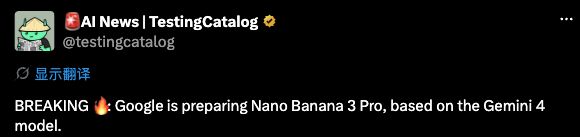
Source: TestingCatalog’s public X post accompanying its October 12, 2026 report; captured October 13. The screenshot retains the account and opening paragraph only. It shows the publisher’s claim, which Google has not confirmed.
Here is what the available information actually answers:
| Question | Current answer |
|---|---|
| Is Nano Banana 3 Pro the final name? | It is the name used in this rumor; final branding could change. |
| Is it based on Gemini 4? | The report connects them, but Google has not confirmed the image model’s foundation. |
| Is there an official date, price, or API model ID? | No corresponding public confirmation was found as of the verification date. |
| Do circulating images establish its performance? | The current report does not provide a reproducible public evaluation or establish superiority over another model. |
There is also a naming trap. Google’s Nano Banana Pro, released November 20, 2025, is officially Gemini 3 Pro Image. An older mention of “3 Pro” may refer to that existing model. Check the date and context before treating it as news about a successor.
Google has publicly introduced Gemini 4 Argon, but that announcement does not give a Nano Banana 3 Pro release date. A new foundation model does not establish simultaneous access to an image model. Sources: Google’s Introducing Nano Banana Pro and Introducing Gemini 4 Argon announcements.
When could Nano Banana 3 Pro launch?
November–December 2026 is a window to watch, not an official schedule. It comes from TestingCatalog’s prediction. It can inform when to look for updates; it should not become a dependency in a delivery plan.
Recent releases explain the interest in another Pro upgrade:
| Date | What happened | Why it matters |
|---|---|---|
| September 8, 2026 | OpenAI released ChatGPT Images 2.5 and the Flare and Sunburst API models. | There is a new reference point for editing and speed. |
| October 6, 2026 | Google made Nano Banana 2.1 generally available. | A newer Nano Banana model is already usable. |
| October 12, 2026 | New Pro development clues were reported. | A reason to follow developments, rather than a launch event. |
| November–December 2026 | The rumored observation window. | Naming, timing, and access remain open questions. |
Sources: OpenAI’s September 8 announcement, the October 6 Gemini API changelog, and TestingCatalog’s October 12 report.
Even if an announcement arrives this year, announcement, initial access, and broad availability could happen separately. An official model page, account eligibility, and API availability will matter more to a production schedule than a rumored month. If the year ends without confirmation, reassess the waiting plan instead of carrying the same rumor forward.
Bookmark our Nano Banana 3 preview page as a place to follow the topic. For work with a firm deadline, use an available model. You can also browse nano banana 3 for image creation and editing ideas.
What does GPT Image 2.5 suggest a new Pro needs to improve?
GPT Image 2.5 puts particular emphasis on how much survives an edit. OpenAI highlights local changes, consistency across revisions, and preservation of reference subjects. It also claims generation latency reductions of up to 50% versus Images 2.0; that is a vendor claim, not a fixed improvement for every workload.
Its API choices provide another useful reference: Flare favors speed, while Sunburst targets more demanding quality and editing work. Our GPT Image 2.5 Flare vs Sunburst guide explains how to choose between them. Sources: OpenAI’s release announcement and official Image prompting documentation.
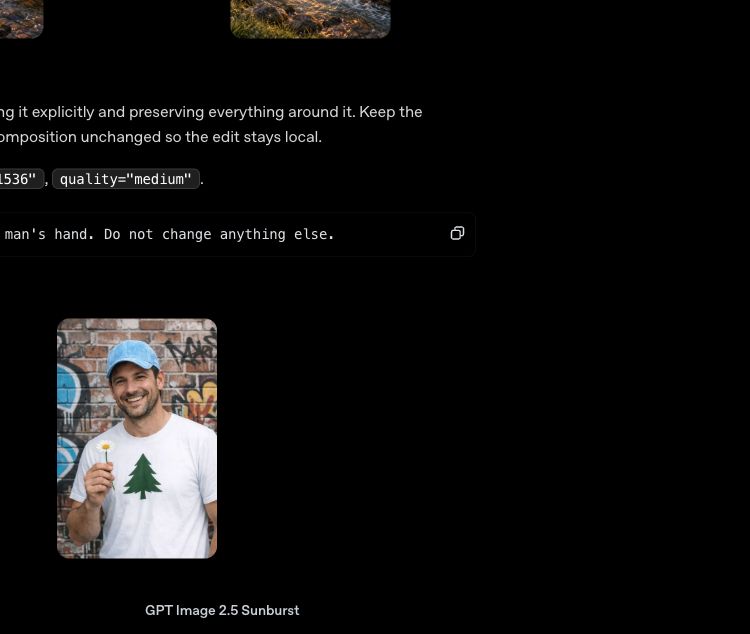
Source: the “Remove an object” example in OpenAI’s official Image prompting documentation, captured October 13, 2026. Input at the top; Flare below left and Sunburst below right. Example settings: 1024×1536, medium. These are official samples, not our tests or Nano Banana 3 Pro outputs.
Look beyond whether the flower disappears. Check the cap, shirt graphic, expression, and background. This small task resembles a real revision request: change one approved asset without disturbing the parts the client already likes.
That makes fewer unwanted changes and more dependable revisions our main expectations for a new Pro. The five directions below are our analysis of current products, not a leaked feature list.
1. More precise local changes and longer editing sequences
Imagine an approved product advertisement that needs a different background, a revised date, and one moved accessory. Rechecking the bottle, label, and composition after every edit can cost more than creating the first image.
This is one of the most useful areas for a Pro upgrade: preserving untouched regions and reducing drift by the third or fourth revision. Evaluate the whole editing sequence, rather than one successful demonstration. Greater stability would still not guarantee pixel-identical preservation of logos or exact typography.
2. Better multilingual text and demanding layouts
Nano Banana 2.1’s official documentation already describes text and infographic-layout improvements. A successor could distinguish itself on harder requests: mixed Chinese and English, prices and units, long product names, and relationships between several blocks of information.
A bilingual café menu illustrates the difference. Attractive lettering is insufficient if a drink gets the wrong price or a portrait variation loses the opening hours. Check correct wording, correct associations, and stable layout separately.
This is a plausible upgrade direction. There is no evidence that Nano Banana 3 Pro will eliminate spelling mistakes or produce natively editable layout files.
3. More consistent people and products across a series
For commerce and content teams, a good single image is the starting point. A bag’s clasp should retain its shape at another angle; a person’s facial features and clothing details should survive a change of scene.
The useful improvement would be more reliable use of references, rather than simply a larger upload limit. Four references that preserve the details can be more valuable than additional inputs that introduce confusion.
After release, try the same subject in close-up, full view, and side view. Compare logo position, proportions, and materials. For current choices, see our Nano Banana 2.1 vs Pro comparison.
4. Better handling of visual relationships
If the rumored foundation-model upgrade is confirmed, complex instruction following will deserve testing: whether arrows connect the correct steps, spatial arrangements make sense, and diagrams represent supplied information faithfully.
The practical expectation is better organization. In a three-step assembly illustration, tools should match actions, steps should follow the right order, and the same component should remain recognizable.
This is a conditional prediction. Clearer presentation would not remove the need to verify the numbers and claims against the input material.
5. A more useful tradeoff between detail, time, and cost
Nano Banana 2.1 already supports 1K, 2K, and 4K output. Merely offering 4K would not distinguish a new Pro. More useful questions are whether details improve at the same delivery size, how often a request needs repeating, and how long difficult edits take.
Measure total cost per accepted image, including generation, retries, and manual correction. A cheaper attempt is not necessarily a cheaper finished asset. A slower model earns its place when it meaningfully reduces rework.
There is currently insufficient evidence to list native 8K, layered PSD export, vector output, unlimited free use, or a fixed speed multiplier as known Nano Banana 3 Pro specifications.
Should you wait for Nano Banana 3 Pro?
| Your situation | Practical choice |
|---|---|
| You need advertising, product, or social images this week. | Use a released model; keep the deadline independent of the rumor. |
| Repeated edits, text, or subject consistency are your main problems. | Save failures and compare the new model on the same tasks once available. |
| You are building a batch image workflow. | Budget with documented models and prices, then evaluate a switch after release. |
| You want to explore next-generation quality. | Follow official access information without prepaying for unannounced benefits. |
You can establish a baseline with Nano Banana 2.1 image generation and editing, then compare your hardest revision tasks with GPT Image 2.5. Keep both sets of outputs so a future upgrade is easier to assess. For more ideas for product campaign visuals, explore nano banana 3 pro.
Three tasks to run when it becomes available
These are original evaluation prompts for this article, not tests already run on Nano Banana 3 Pro. Use images you have permission to edit. Fix the source image, instructions, and output size; attempt each task three times and retain failures.
Task one: change only a product’s color.
Change the body of the travel mug in the reference image to dark green. Preserve the lid, handle, brand lettering, proportions, camera angle, background, and shadows. Add no text or accessories.
Inspect every non-color change, particularly the lettering, rim, and handle attachment.
Task two: make a bilingual poster.
Design a café poster with exactly these three lines: “秋日特调 / AUTUMN SPECIAL”, “桂花拿铁 / OSMANTHUS LATTE”, and “¥28”. Make the product name and price clearly associated. Leave generous whitespace and add no other text.
Check Chinese characters, English spelling, the currency symbol, and reading order at full size.
Task three: revise the same image repeatedly.
Round one: change only the background to a light-gray studio. Round two: move only the accessory on the right to the left. Round three: change only the composition to a 4:5 portrait format. At every step, preserve subject identity, product structure, text, and all previously completed edits.
Check whether earlier requirements survive each round. Record retries and correction time. For additional tasks close to your work, explore the Nano Banana prompt library.
Other questions readers are asking
Will Nano Banana 3 Pro be free?
No free allowance or subscription arrangement has been confirmed. Limited application access, if offered, could be separate from API billing. Budget against the currently available plans and credits, without treating existing plans as a promise of future model access.
Will it replace Nano Banana 2.1?
There is no official statement. Speed-oriented and quality-oriented options can coexist, so the name alone does not imply an immediate replacement. Our Nano Banana 2.1 release guide covers the current model.
Will it beat GPT Image 2.5?
That cannot be established yet. After release, compare text, local editing, revision sequences, subject consistency, and cost per accepted image separately. A model that repeatedly meets your requirements is more useful than one with an occasional exceptional sample.
Can developers use a Nano Banana 3 Pro API now?
As of the verification date, no official public API model ID or access instructions corresponding to this new-model rumor were found. Gempix 3 Pro is an internal reference, not a documented callable identifier. Check parameters, regions, limits, and pricing when public documentation appears.
The most useful preparation for Nano Banana 3 Pro is to save the difficult tasks in your current workflow. Once access arrives, ask it to edit the same image and preserve the same details. That gives you a concrete basis for deciding whether to upgrade.