

GPT Image 2 vs Nano Banana Pro: Which AI Image Model Is Better for Text, Editing, and Production Workflows?
If you are choosing between GPT Image 2 and Nano Banana Pro, the real question is not which model looks better in a vacuum. It is which one gets you to a usable image faster for the kind of work you actually do.
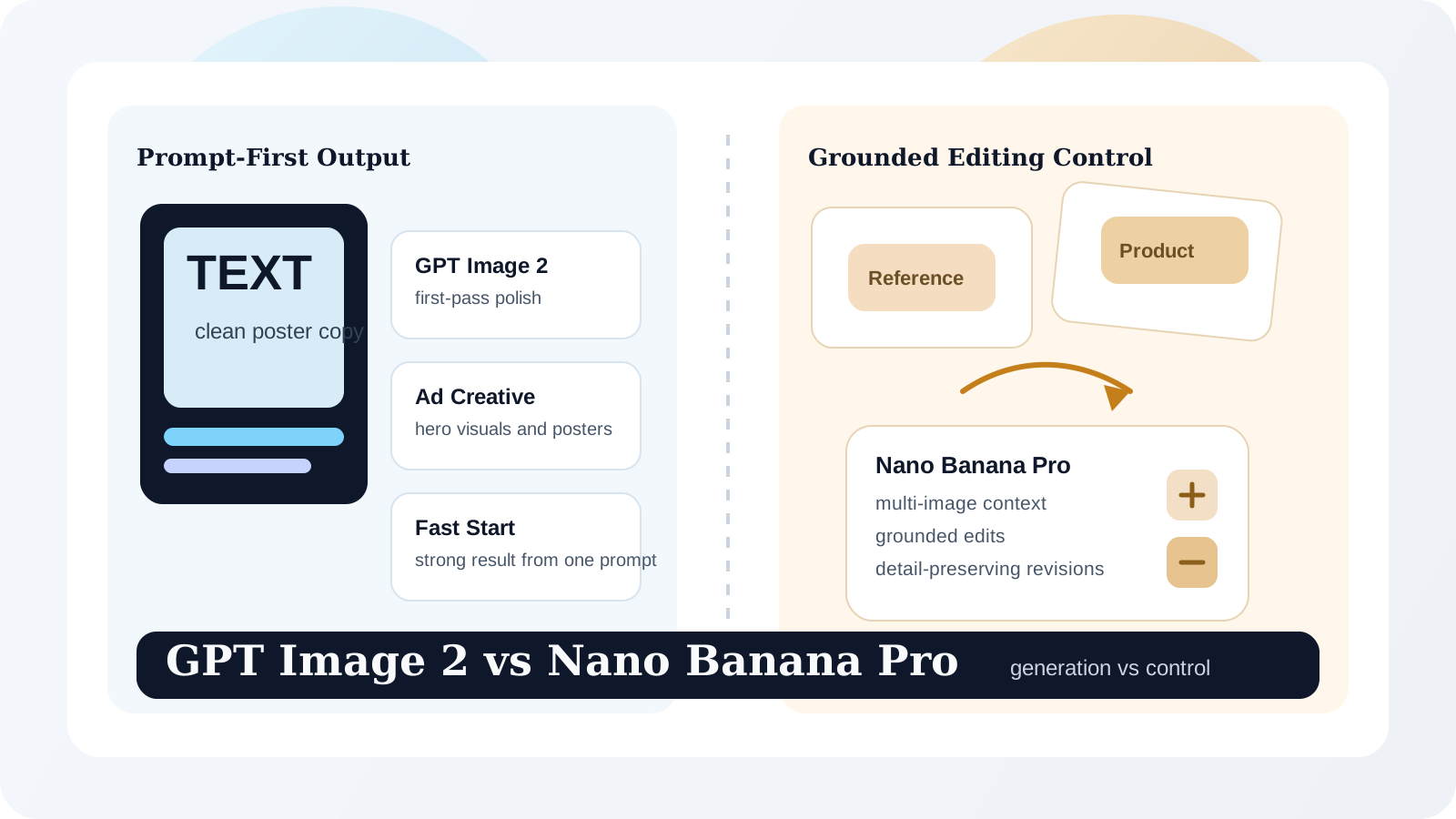
The short version is simple. GPT Image 2 is the stronger default pick for polished first-pass generation, readable text, and general-purpose commercial visuals. Nano Banana Pro is the stronger pick when your workflow depends on grounded edits, multi-image control, and complex iterative changes.
That sounds close on paper, but in practice the gap becomes obvious once you care about text rendering, edit fidelity, character consistency, or product mockups that need several rounds of revision.
GPT Image 2 vs Nano Banana Pro: The Short Answer
If you want the fastest recommendation, use this:
- Choose GPT Image 2 for cleaner first-pass outputs, stronger general prompt-to-image generation, and more straightforward production use when you need ads, posters, app visuals, or branded assets quickly.
- Choose Nano Banana Pro for complex editing workflows, grounded image generation, product mockups, and projects where multiple reference images or instruction-heavy revisions matter more than a one-shot win.
- Choose GPT Image 2 if your team mostly starts from text prompts.
- Choose Nano Banana Pro if your team mostly starts from existing images, references, or real-world products.
That is the practical buying decision. The rest of the article explains why.
What Nano Banana Pro Actually Refers To
Nano Banana Pro is not just a nickname from review sites. Google’s own Gemini API documentation explicitly maps Nano Banana Pro to Gemini 3 Pro Image Preview (gemini-3-pro-image-preview).
Google positions it as the higher-end image model in the Nano Banana family, designed for professional asset production, complex instructions, high-fidelity text, and real-world grounding using Google Search. Google also highlights 4K output, multi-image support, and a default reasoning layer that refines composition before generation.
That framing matters, because it tells you what Google thinks the model is for. Nano Banana Pro is not meant to be a lightweight toy image generator. It is aimed at commercial-grade visual work where control matters.
What We Mean by GPT Image 2
The OpenAI side is slightly messier in public naming, but the market signal is still clear.
OpenAI’s public rollout has been surfaced as ChatGPT Images 2.0, while partner and ecosystem references use gpt-image-2. Search result snippets from OpenAI and partner listings describe it as a state-of-the-art image generation model with improved text rendering, multilingual support, and advanced visual reasoning.
For this article, GPT Image 2 refers to that newer OpenAI image generation stack rather than an older DALL-E-style naming convention. That distinction is worth making because many comparison articles blur model branding and product branding together, which makes the advice less reliable.
Text Rendering: Which Model Handles Labels, Posters, and UI Copy Better
This is one of the most important categories, because it is where image models stop being fun and start becoming useful.
If your output includes package labels, poster headlines, menu boards, social ads, UI mockups, or infographic-style visuals, text accuracy is not a nice extra. It is the whole job. A beautiful image with broken copy still fails.
On the evidence currently available, both models are serious about text rendering, but they get there from slightly different angles.
Google explicitly says Nano Banana Pro is built to follow complex instructions and render high-fidelity text. That is a strong official claim, and it lines up with the kind of work Google showcases in its image-generation documentation.
GPT Image 2 also appears to be positioned around this same capability. Public launch snippets tied to OpenAI’s rollout describe improved text rendering as one of the headline upgrades, which fits the way users are already treating it in production workflows.
The practical difference is this:
- GPT Image 2 looks like the safer pick for broad text-heavy creative work where you want a strong result from the first prompt.
- Nano Banana Pro looks stronger when the image needs both accurate text and several rounds of deliberate correction, grounding, or layout-aware revision.
If all you care about is generating a clean poster or hero visual with readable copy, I would lean GPT Image 2. If the job is “generate this asset, then refine it against references and real-world context,” I would lean Nano Banana Pro.
Image Editing Fidelity: Which One Follows Instructions More Reliably
This is where many comparison posts stay too shallow. Image quality is easy to notice. Editing reliability is what affects day-to-day production.
Nano Banana Pro has a more explicit official story here. Google positions it around complex instructions, composition reasoning, multi-image inputs, and high-fidelity preservation. In plain English, that means it is being built for workflows where you say things like:
- keep the packaging shape, but change the branding
- preserve the subject and camera angle, but replace the background
- combine these references into one photoreal product scene
- keep the layout, but swap the headline and color system
That is exactly the kind of editing work where a model either saves time or creates more of it.
GPT Image 2 is still highly relevant in editing. OpenAI’s newer image systems increasingly support tighter instruction following and iterative changes, and that is part of why the model is attractive to creative teams. But if your workflow is edit-heavy rather than generation-heavy, Nano Banana Pro has the clearer official positioning advantage right now.
My take is straightforward: GPT Image 2 wins the “strong result fast” category, while Nano Banana Pro wins the “controlled revision over multiple rounds” category.
Character and Identity Consistency Across Variations
Consistency is where a lot of image demos collapse under real work.
Generating one beautiful frame is easy to celebrate. Generating ten related assets that keep the same person, product, mascot, or scene logic is much harder. This is where commercial teams start caring about model behavior instead of pure wow factor.
Nano Banana Pro has an advantage on paper because Google explicitly supports richer multi-image context and positions the model for more demanding asset-production workflows. That makes it a more natural candidate for:
- recurring product campaigns
- character-preserving edits
- brand systems with multiple deliverables
- reference-heavy e-commerce or marketplace graphics
GPT Image 2 can still be strong here, especially if your pipeline is set up around prompt discipline and iterative selection. But if consistency across many variations is the main requirement, I would currently trust Nano Banana Pro more than I would trust a one-shot generation-first workflow.
Photorealism, Product Mockups, and Commercial Visuals
This is where the choice gets more nuanced.
For pure photoreal first-pass generation, GPT Image 2 is very compelling. It appears built to produce high-quality marketing images, branded visuals, and polished compositions without needing a lot of setup. That matters for studios, AI tools, and content teams that need volume and speed.
Nano Banana Pro is not weak here. In fact, Google’s own documentation explicitly calls out product mockups or creative collages as a fit for the model. But the strength sounds less like “best single render from a fresh prompt” and more like “best controlled system once references, edits, and grounding enter the workflow.”
Here is the distinction that matters:
- For ad creatives, editorial covers, social assets, and clean prompt-to-image output, GPT Image 2 is probably the more efficient default.
- For product composites, grounded commercial scenes, or mockups that need multiple inputs and revision control, Nano Banana Pro is probably the better operational choice.
That is not a contradiction. They are optimized around different kinds of friction.
Speed, Workflow Friction, and Production Fit
The wrong way to judge speed is by timing a single render. The right way is to ask how long it takes to get something publishable.
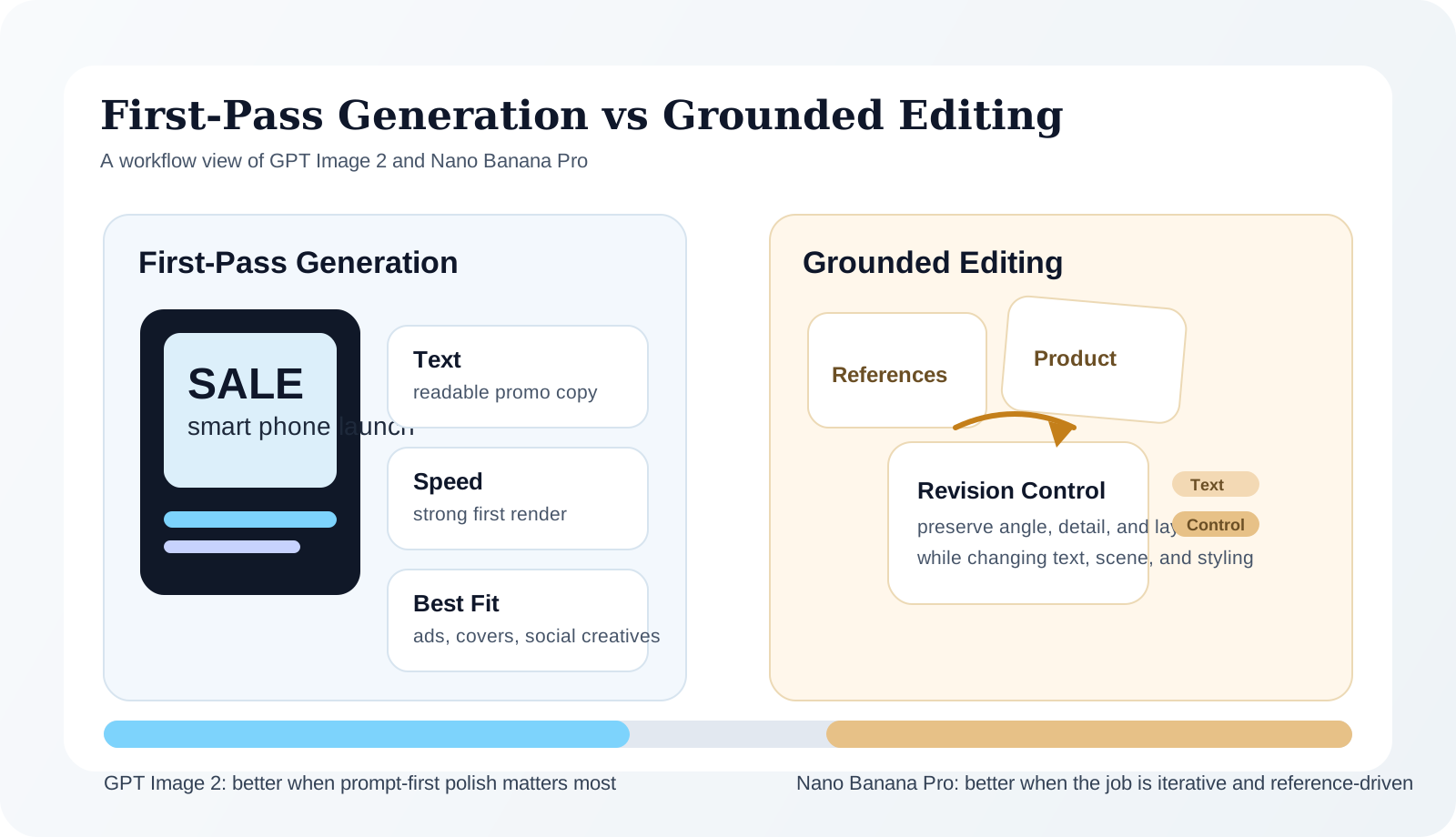
If you type one prompt and need a polished image quickly, GPT Image 2 will usually feel faster because the workflow is more generation-first. If you already know the image will go through several revisions, Nano Banana Pro can be faster overall because you lose less structure while editing.
This matters a lot in production:
- Content teams usually benefit more from better first-pass output.
- Design ops teams usually benefit more from controllable revision.
- E-commerce teams often need both, but tend to care more about preservation and consistency once the asset base scales.
The practical mistake is choosing a model based on one viral example instead of the actual workflow bottleneck.
Where Nano Banana Pro Wins
Nano Banana Pro is the better choice when these are the deciding factors:
- you need grounded image generation tied to real-world context
- you need multi-image composition or stronger reference use
- you care about preserving details across edits
- your workflow involves iterative instruction-heavy refinement
- you are producing commercial assets where consistency beats pure novelty
If your image pipeline feels more like visual operations than pure creativity, Nano Banana Pro makes more sense.
Where GPT Image 2 Wins
GPT Image 2 is the better choice when these are the deciding factors:
- you want stronger first-pass images from text prompts
- you need readable text in posters, product graphics, or marketing visuals
- you want broad commercial usefulness without a complex editing loop
- you care more about output polish than grounded compositing
- your team wants a model that feels immediately productive for generation-first work
If your image pipeline starts from prompts more often than references, GPT Image 2 is usually the better fit.
Which Model Should You Choose for Different Use Cases
Here is the simplest way to map the choice to real work.
Choose GPT Image 2 if you do:
- ad creatives
- blog covers
- social graphics
- poster-style visuals
- app marketing images
- text-heavy promo assets
Choose Nano Banana Pro if you do:
- product mockups
- image-to-image transformations
- grounded commercial scenes
- reference-based campaigns
- character-preserving edits
- multi-step brand asset refinement
If you are an agency or internal creative team
Use GPT Image 2 as the faster general generator and Nano Banana Pro as the more surgical editing model. In many teams, that is the real answer. One handles speed and surface quality. The other handles control and preservation.
Final Verdict
If I had to make the call in one sentence, it would be this:
GPT Image 2 is the better all-around choice for prompt-first image generation and text-heavy commercial assets, while Nano Banana Pro is the better specialist for grounded editing, controlled revisions, and reference-driven production work.
That means there is no universal winner.
If your success metric is “how often does the first result look good enough to use,” choose GPT Image 2.
If your success metric is “how reliably can I push the same image system through multiple precise edits without losing the plot,” choose Nano Banana Pro.
That is the difference that actually matters in production.
FAQ
Is GPT Image 2 an official OpenAI model name?
OpenAI’s public rollout has also appeared as ChatGPT Images 2.0, while ecosystem and partner references use gpt-image-2. In practice, people use “GPT Image 2” as shorthand for that newer OpenAI image stack.
Is Nano Banana Pro the same as Gemini 3 Pro Image Preview?
Yes. Google’s Gemini API documentation explicitly maps Nano Banana Pro to Gemini 3 Pro Image Preview (gemini-3-pro-image-preview).
Which model is better for text in images?
Both appear strong, but GPT Image 2 looks better for general generation-first text-heavy creative work, while Nano Banana Pro looks stronger for text-heavy images that also need controlled edits, grounding, or multi-step refinement.
Which one is better for product mockups and ads?
For product mockups with references, revisions, or compositing needs, Nano Banana Pro is the safer choice. For fast ad visuals and first-pass commercial images, GPT Image 2 is usually the better starting point.
Which one is better for iterative editing?
Nano Banana Pro. That is the clearer official positioning, and it matches the way Google presents the model in its image-generation documentation.