

Imagen 4 vs Nano Banana: Which AI Image Model Is Better in 2026?

Choosing between Imagen 4 and Nano Banana comes down to one practical question: do you need the strongest possible image generation from a prompt, or do you need a smoother way to edit and refine images over multiple rounds?
For most people, that is the real difference.
Imagen 4 is usually the stronger choice when the goal is high-quality image generation from scratch. Nano Banana becomes more compelling when the job involves editing, transformation, reference-based changes, or back-and-forth visual iteration.
That is why these two names keep showing up in the same comparison. They overlap, but they do not feel strongest in exactly the same kind of workflow.
The short answer: Imagen 4 or Nano Banana?
If you want the quickest recommendation, use this:
- Choose Imagen 4 for polished prompt-to-image generation, realism, detail, and cleaner visual output
- Choose Nano Banana for conversational editing, image transformations, and faster iteration across multiple changes
- Choose Nano Banana Pro if consistency and commercial-grade output matter more than casual experimentation
- Choose Nano Banana 2 if you want a lighter option in the same ecosystem
That summary will be enough for some readers. For everyone else, the useful part is understanding where those differences show up in real work.
What people mean by Imagen 4, Nano Banana, Pro, 2, and Ultra
Part of the confusion comes from the fact that people often compare not just two names, but a whole family of related options.
Imagen 4
Imagen 4 is best understood as a generation-first image model. It is typically associated with strong text-to-image quality, sharper prompt adherence, photorealistic output, and more polished first-pass results.
If you want to type a prompt and get a high-quality image without much cleanup, Imagen 4 is the more obvious fit.
Imagen 4 Ultra
Imagen 4 Ultra usually comes up when the comparison shifts toward premium quality, stronger realism, finer texture, and more demanding visual output. It is the version people mention when they want the best-looking result, not just a good-enough one.
Nano Banana
Nano Banana tends to feel different because it is often discussed less as a single-shot generator and more as a flexible image workflow. It is especially attractive when you want to revise an image, preserve useful parts of a previous output, combine references, or make directed changes through natural language.
Nano Banana Pro
Nano Banana Pro is the more advanced option in that family. It makes the most sense when the output needs to feel more reliable, more consistent, or more commercially usable across repeated tasks.
Nano Banana 2
Nano Banana 2 sits in the same ecosystem, but it is often treated as a lighter or more accessible option. For some users, that matters more than chasing maximum output quality.
The useful way to think about the whole comparison is this: Imagen 4 is strongest when generation quality comes first, while Nano Banana is strongest when the workflow depends on editing and controlled iteration.
Imagen 4 vs Nano Banana at a glance
| Category | Imagen 4 | Nano Banana |
|---|---|---|
| Best for | High-quality text-to-image generation | Conversational editing and iterative visual changes |
| Core strength | Image fidelity, composition, clarity | Editing flexibility, transformation workflows |
| Prompt-to-image quality | Usually stronger | Strong, but often less defined by first-pass output |
| Editing existing images | Good, depending on tool layer | Usually a bigger advantage |
| Multi-image workflows | Possible in some setups | Often a central part of the appeal |
| Character or object consistency | Can be good, but depends on workflow | Often easier to manage over multiple revisions |
| Ease for non-technical users | Strong with a simple interface | Strong when chat-based editing is implemented well |
| Best fit | Users who want the best generated image | Users who want to refine images over time |
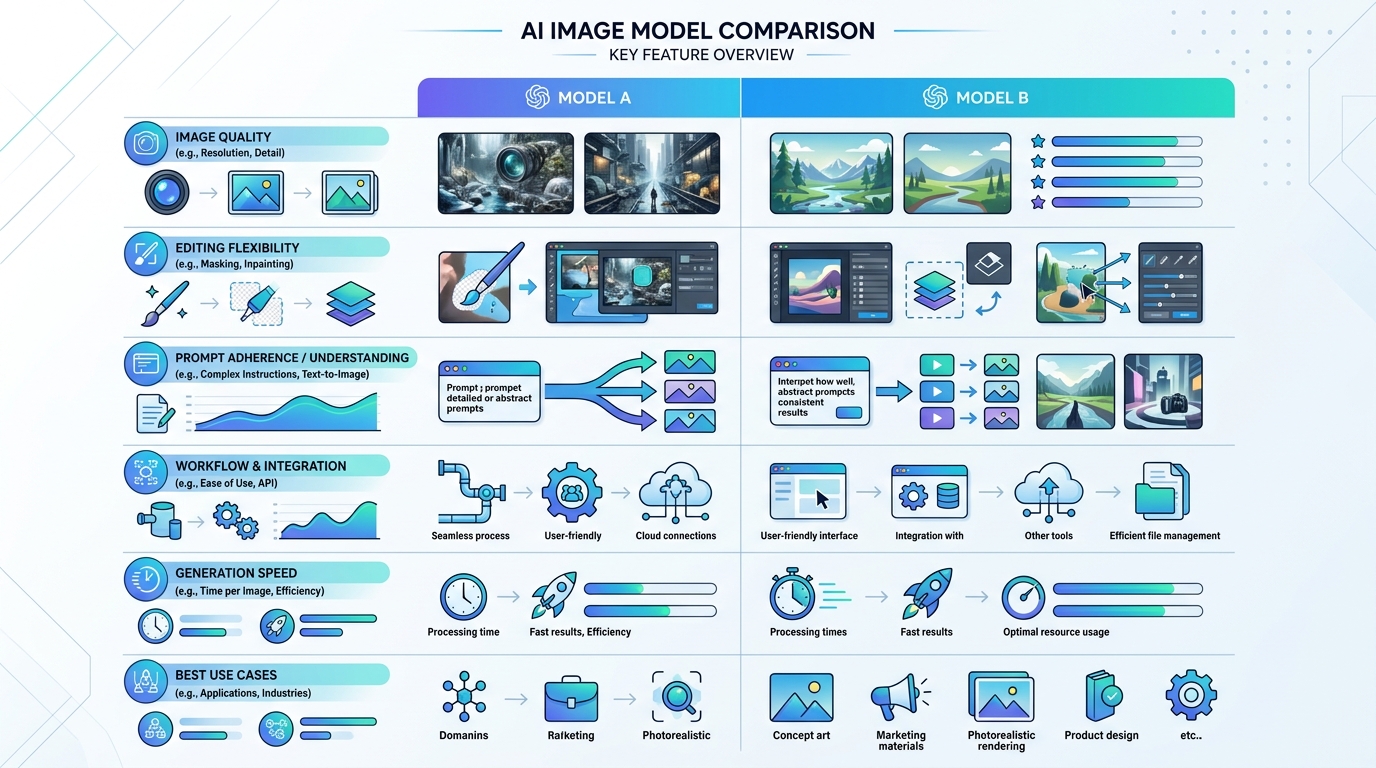
A quick table helps, but most decisions come down to quality, editing, speed, and the kind of work you actually do.
Image quality: which one looks better?
If the goal is a fresh image generated from a prompt, Imagen 4 usually has the stronger case.
Its appeal is straightforward: better first-pass polish, stronger realism, cleaner lighting, and a higher chance of getting close to the intended result without much follow-up. That matters when the output needs to look production-ready quickly.
Nano Banana is not weak on quality. It simply becomes more valuable in a different way. The question is often less “Which model makes the single best image?” and more “Which model gets me to the right image faster?”
Photorealism and detail
For photorealistic scenes, product-style visuals, and detailed compositions, Imagen 4 is usually the safer bet. It is better aligned with workflows where the first render does a large share of the work.
That makes it a strong choice for:
- hero images
- polished product visuals
- brand-led creative work
- scenes where texture, lighting, and realism matter immediately
Style consistency and scene control
Nano Banana becomes more attractive when the job does not end after one generation. If the task is to keep the same subject, change the environment, adjust the composition, or preserve important visual structure across multiple rounds, its strengths become easier to see.
In those cases, controllability can matter more than raw first-pass polish.
Text rendering and design-heavy outputs
Text rendering is one of the most useful differences in commercial work. Ad creatives, product graphics, thumbnails, and marketing visuals often fail when the model mishandles words or layout logic.
Imagen 4 is often the safer choice when readable in-image text, cleaner composition, and more design-aware output matter. If the job depends on assets that feel presentation-ready, that can be a decisive advantage.
Editing workflow: where Nano Banana can beat Imagen 4
This is where Nano Banana often becomes the better choice.
Many real workflows are not about generating one perfect image. They are about fixing, refining, adapting, and reworking images until they match a specific need. In that kind of environment, editing convenience is not a side benefit. It is the product.
Chat-based editing
One of Nano Banana’s biggest strengths is how naturally it fits conversational editing. Instead of rebuilding a prompt every time, you can move the image forward through specific instructions.
That makes a difference in everyday use. A model can look brilliant in a static comparison and still feel slow in practice if every correction forces you to restart the process.
Multi-image blending and transformations
Nano Banana also makes more sense when the task involves combining references, reworking an existing image, or transforming a previous result into something new.
That can be especially useful for:
- e-commerce creative production
- social media asset variation
- reference-driven concept work
- campaign iteration
- marketing teams that need many related outputs quickly
Character and object consistency
Consistency is another area where an editing-first workflow can feel more practical. If a product, person, mascot, or recurring visual style needs to stay recognizable across multiple assets, Nano Banana Pro can be the better fit.
For many commercial teams, that kind of consistency matters more than winning a one-shot image-quality contest.
Speed and usability
Speed is not only about generation time. It is also about how quickly you arrive at something usable.
Which model feels faster in real workflows?
If one model makes a stronger first image, it may feel faster when the task is simple. If another model makes revisions easier, it may feel faster when the task is iterative.
That is why both of these can be true at the same time:
- Imagen 4 feels faster when the first result is already close to the goal
- Nano Banana feels faster when the image needs several rounds of targeted changes
The more revision-heavy the work, the more Nano Banana’s workflow advantages start to matter.
Which one is easier for non-technical users?
The easier model is usually the one that matches how you think.
If you naturally think in prompts, scenes, aesthetics, and visual generation goals, Imagen 4 can feel direct. If you naturally think in edits like “keep this, change that, brighten the background, preserve the subject,” Nano Banana can feel more intuitive.
Workflow differences matter more than spec sheets
A lot of comparisons become misleading because they flatten everything into one winner. In practice, these tools often feel different not because one is universally better, but because they reduce different kinds of friction.
If your friction is getting a strong image from scratch, Imagen 4 solves that better. If your friction is revising an image without losing control, Nano Banana often solves that better.
Nano Banana Pro vs Nano Banana 2 vs Imagen 4
The bigger decision is not always just Imagen 4 vs Nano Banana. Sometimes it is a question of how much quality, consistency, and workflow control you actually need.
Choose Imagen 4 if you want the strongest generation-first experience
Imagen 4 makes the most sense if your priorities sound like this:
- strong prompt-to-image quality
- realism, detail, and polish
- better first-pass output
- cleaner text rendering and more design-ready results
Choose Nano Banana if you want a flexible editing workflow
Nano Banana makes more sense if your priorities sound like this:
- editing matters more than one-shot generation
- you want to transform images through natural language
- you need to iterate quickly without restarting every time
- workflow flexibility matters as much as image quality
Choose Nano Banana Pro if consistency and commercial output matter most
Nano Banana Pro is a better fit when you need:
- stronger repeatability
- more reliable consistency across outputs
- a workflow suitable for campaigns, client work, or structured visual systems
- a more serious version of the editing-first experience
Choose Nano Banana 2 if you want a lighter option
Nano Banana 2 is often the better fit if you care more about practical day-to-day use, accessibility, or a lower barrier to entry.
That makes it appealing to users who want the workflow benefits of the Nano Banana ecosystem without always needing the highest-end setup.
Which model should you choose?
The simplest way to decide is to match the model to the job.
Choose Imagen 4 if…
- you mostly create new images from text
- photorealism is a top priority
- you care about polished composition and detail
- readable in-image text matters for your use case
- you want a premium generation-first model
Choose Nano Banana if…
- you regularly edit existing images
- you want conversational revisions
- your workflow depends on transformations, not just creation
- you often work from references or previous outputs
- speed of iteration matters more than one-shot perfection
Choose Nano Banana Pro if…
- you need stronger consistency across outputs
- you are making commercial or marketing assets
- your workflow is more demanding than casual generation
- you want the Nano Banana experience with more reliable output
Choose Nano Banana 2 if…
- you want a more accessible version in the same family
- practical use matters more than top-end output
- you want a lighter path before moving into Pro-level usage
Is Nano Banana better than Imagen 4?
Sometimes, yes.
If the work depends on editing, preserving structure, applying targeted changes, or moving through multiple rounds of revision, Nano Banana can be more useful than Imagen 4 even if Imagen 4 looks stronger in a pure image-generation comparison.
If the main goal is generating a polished image from scratch, Imagen 4 usually has the stronger case.
Is Nano Banana Pro better than Imagen 4 Ultra?
That depends on what matters more.
If the priority is top-end visual quality, realism, texture, and polished output, Imagen 4 Ultra may be the better fit. If the priority is controlled iteration, editing flexibility, and consistency across repeated changes, Nano Banana Pro may be the smarter choice.
Neither answer is contradictory. They are simply optimized for different definitions of “better.”
Which is better for e-commerce creatives?
For e-commerce work, Nano Banana can be especially attractive because e-commerce creative production is rarely one-and-done. Teams often need to test new backgrounds, adapt product scenes, create campaign variations, and update assets quickly.
Imagen 4 is still a strong choice when the goal is producing a polished hero visual or premium product image from scratch.
A practical rule is this:
- choose Imagen 4 for flagship generation quality
- choose Nano Banana for iterative creative production
- choose Nano Banana Pro when consistency and commercial reliability matter most
Which is better for editing existing images?
Nano Banana is usually the better answer.
That is the clearest difference in the comparison. If the workflow starts with an existing image and the job is to adapt, refine, restyle, combine, or progressively improve it, Nano Banana is typically the more natural fit.
Final verdict
If the decision is reduced to one sentence, it is this: Imagen 4 is generally stronger for generation, while Nano Banana is generally stronger for editing.
But the useful answer is slightly more specific.
Choose Imagen 4 when success means getting a high-quality image from a prompt with as little compromise as possible.
Choose Nano Banana when success means controlling and improving the image through multiple rounds of changes.
Choose Nano Banana Pro when that editing-first workflow also needs to hold up in more serious commercial use.
Choose Nano Banana 2 when a lighter path inside the same ecosystem makes more sense.
For most people, the best model is not the one with the most impressive description. It is the one that makes the actual work easier.